The Post-Trump MAGA has been born, with the Tech Oligarchy at its core
The impossibility of United States President Donald Trump running for a third term without constitutional ruses, and the debate over his…

The impossibility of United States President Donald Trump running for a third term without constitutional ruses, and the debate over his succession, began in 2019 at a discreet meeting in a hotel in the town of Rockbridge, Ohio. Over several days of conversations and networking, the cream of the country’s technological oligarchy, Silicon Valley investors, and rising politicians in the Republican Party were brought together. The network formed at that event aims to reconfigure how the conservative economic elite of the US will lead national politics in the coming years. Last week, a project emerged that mapped these relationships with the US federal government and their strategic influence on the future of the Make American Great Again (MAGA) movement, around which the far-right forces that brought Trump to his second term have coalesced.
A recent article in The Washington Post [1] profiled the main organiser of the Rockbridge Network, Chris Buskirk. An Arizona businessman, Buskirk is the central figure in the restructuring of MAGA, transforming it from a phenomenon centred on the personality of Donald Trump into a lasting and institutionalised political force. He acts as the architect behind the organisation of donors and strategists that brings together conservatives such as billionaire Peter Thiel, the Vice President JD Vance, and Donald Trump Jr. Buskirk’s philosophy, described as “aristo-populism,” advocates for the need for a “productive elite,” an aristocracy of business leaders and innovators, to guide the country. This new vanguard, according to him, is not in conflict with the populist base of MAGA but rather at its service, with the aim of reindustrialising the country and aligning the interests of capital with those of the working class.
One of its objectives is to promote JD Vance as the natural successor to the movement, potentially for the presidential candidacy in 2028. The group’s strategy involves creating an organisational infrastructure that the pro-Trump movement lacked in its early days, using militant engagement tactics inspired by left-wing agitation and propaganda manuals to build relationships of trust with potential voters long before the elections.
The profile in Jeff Bezos’s newspaper highlights how this strategic alliance between the new political right, technology sector billionaires, and the current government has strengthened the ties between these sectors to structure the country’s current administration. With significant funding from technology leaders like Thiel, and the involvement of others such as Marc Andreessen and David Sacks, Rockbridge has become a meeting point for the new power class in Washington. Buskirk’s venture capital firm, 1789 Capital, which includes Donald Trump Jr. as a partner, exemplifies this fusion, investing in “patriotic capitalism” and “anti-woke” companies. This symbiotic relationship is criticised by some as a form of “pay to play,” where policies favourable to technology and cryptocurrencies are exchanged for financial and strategic support, raising questions about whether the movement benefits the working class it claims to represent or a new American oligarchy.
The Map
The fingerprints of this group were thoroughly captured by the Authoritarian Stack project (https://www.authoritarian-stack.info) [2], coordinated by researcher Francesca Bria and investigative journalist José Bautista. The initiative mapped how some technology companies and their allies are privatising state functions in an integrated “stack” of power that has begun to call the shots in the so-called American military-industrial complex. Dubbed the “authoritarian stack,” the platform combines layers of technological and financial infrastructure (cloud, AI, payment methods, drone networks, and orbital systems) operating as an integrated architecture of technopolitical control. Unlike traditional authoritarianism, which depends on mass mobilisation and violence, this stack operates through infrastructural dependence and financial coordination, shifting the centre of sovereignty to corporations and their investment funds.
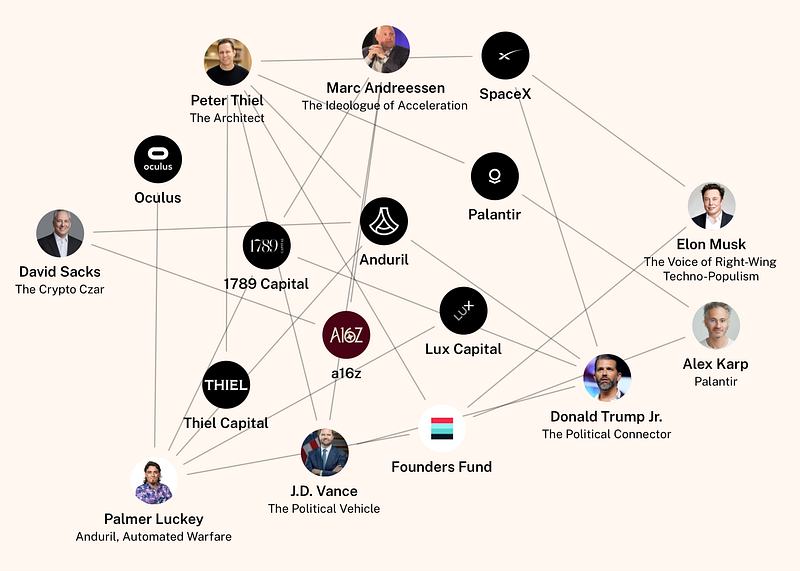
According to Bria [3], the project originated from the analysis of a contract worth $10 billion signed in July between the US Army and Palantir, a company founded by Thiel. The deal consolidated 75 public procurement agreements into a single document, establishing the company, in the researcher’s words, as the de facto operating system of the United States government.
This transfer [of powers and assets] means that decisions about targets, troop movements, and intelligence analysis are increasingly passed through algorithms governed not by a military command, but by a corporate board accountable to shareholders. The army was not just buying software; it was ceding operational sovereignty to a platform without which it can no longer function.
From the analysis of the project’s data, it is clear that the symbiosis between the state and large technology corporations is underpinned by structural and organisational mechanisms that compromise governmental autonomy. Through contractual consolidations and deep technical integration, state agencies become captive to proprietary platforms, in a kind of infrastructural lock-in. This dependence not only makes it difficult to replace suppliers but also obstructs public auditing and the state’s technological sovereignty.
Simultaneously, organisational integration deepens these ties, with the appointment of private sector executives to strategic posts in military, security, and science and technology structures, in addition to the proliferation of public-private partnerships that dissolve the institutional barriers between corporate interests and state functions. Emblematic examples include Thiel’s former chief of staff, Michael Kratsios, serving as the coordinator of the White House Office for Science and Technology’s policy, former Palantir executive Gregory Barbaccia in the role of Federal Chief Information Officer, and Michael Obadal, an Anduril employee, appointed as Under Secretary of the Army. Executives from companies like Meta, OpenAI, and Palantir have been commissioned into the Army (Detachment 201), signalling a direct exchange between corporate leadership and military command, with potential influence on the definition of the state’s technological requirements and priorities.
This symbiosis is reinforced by a powerful political-financial alignment, in which investment funds and donors with specific ideological agendas channel capital to companies strategically positioned to assume critical defence, security, and data management functions. A good example of this is the rise of Buskirk’s 1789 Capital fund to over $1 billion in assets, connecting ideological financing and the expansion of critical state platforms. Such a dynamic creates a closed circuit where financing, political influence, and government contracts feed back into each other, consolidating the power of a small number of actors.
To justify this capture of state functions, a discursive legitimation based on the rhetoric of technological sovereignty and “patriotism” is applied. This discourse skilfully shifts the public debate from democratic control and transparency to a logic of private sector efficiency and innovation, minimising the risks associated with the loss of sovereignty and the erosion of public governance. Investors and ideologues like Thiel, Elon Musk, Marc Andreessen, David Sacks, Palmer Luckey, and Alexander Karp promote an agenda that normalises the outsourcing of state sovereignty to private infrastructure, justifying it as modernisation and efficiency in defence and governance.
Global presence
The Pentagon’s contract with Palantir crowned the company’s global visibility, enabling a transnational expansion in the surveillance and security segments. Police forces in Germany have adopted Palantir’s IT systems, while the UK’s National Health Service (NHS) signed a £330 million contract for the company to process sensitive data of British citizens [4]. In the defence area, this same type of relationship provided a showcase for Elon Musk’s Starlink to begin operating in defence missions in Italy and to secure contracts with public bodies in Brazil [5].

If Palantir is the data backbone of the authoritarian state, Bria considers Anduril to be its autonomous warfare command system.
Its Lattice platform connects satellite feeds, radar data, and battlefield imagery into a single operational network, allowing military missions to be planned and executed automatically. The company claims its systems can operate at level 5 autonomy, that is: identify targets, attack, and return without human intervention.
The implications of the growing integration between the state and technology corporations culminate in an effective privatisation of sovereignty, a phenomenon that redefines the boundaries of public power. Functions historically central to the state, such as defence, surveillance, and strategic logistics, now operate under the logic of corporate governance, shifting the axis of accountability from democratic institutions, such as parliaments and courts, to the boards of directors of private companies.
This process entails a profound regulatory and democratic risk, as the opacity of contracts and the dependence on proprietary technologies create almost insurmountable barriers to independent auditing and legislative control. The protection of civil liberties becomes precarious, and the negative effects are amplified on a global scale, since the technological infrastructure that supports these operations is, for the most part, transnational and controlled by a small number of actors.
Opacity versus scrutiny
Faced with this scenario, it is imperative to build a public policy agenda aimed at reasserting democratic control and state sovereignty. Such an agenda must begin by strengthening public procurement mechanisms that demand transparency, interoperability, and the use of open and auditable standards, reducing technological lock-in. It is equally crucial to implement rigorous scrutiny of conflicts of interest and the “revolving door” phenomenon between the public and private sectors.
Additionally, full transparency must be demanded regarding the algorithms and data used in sovereign functions, ensuring that critical decisions are not delegated to corporate “black boxes”. Ultimately, the most robust strategy consists of investing in the creation of public alternatives and sovereign digital infrastructures, capable of competing with private solutions and ensuring that the state maintains control over its essential functions. This applies both to the United States and to the Global South.
But how can this be done with a MAGA movement bolstered by Silicon Valley capital? This first year of the Trump administration has made it clear that reactive measures to the advance of big tech will be placed in the ideological package of the American state as cases to be combatted not just with tariff barriers. The Rockbridge network will strengthen even more in the near future when one of its most notorious members reaches the Oval Office. Anticipating the foretold disaster by blocking agreements with these companies is what can prevent America from being made great again beyond its borders.
References
[1] https://www.washingtonpost.com/technology/2025/11/04/chris-buskirk-maga-vance-post-trump/
[2] The project was launched in early November and has a research and editing team led by Bria, with data analysis by the Autonomy Institute and map development by xof-research.org. The researchers had support from the Rosa Luxemburg Stiftung and were financed by the Friedrich-Ebert-Stiftung (FES). The mapping is based on an open dataset with more than 250 agents, thousands of verified connections, and about $45 billion in documented financial flows. (https://www.authoritarian-stack.info)
[3]https://mondediplo.com/2025/11/02tech
[4] This contract was extended to the Brazilian Ministry of Health during the Bolsonaro government with the Better Health Programme (BHP), as shown by Lapin and Cebes: https://lapin.org.br/wp-content/uploads/2024/07/Relatorio-BHP-e-DD.pdf. It was renewed last month by Minister Alexandre Padilha: https://www.gov.br/saude/pt-br/assuntos/noticias/2025/outubro/em-londres-ministro-padilha-renova-parceria-com-reino-unido-para-fortalecimento-do-sus