On Internet and Internets
From unilateral governance to the territorialisation of networks: architectures, cases, and future sovereign scenarios
From unilateral governance to the territorialisation of networks: architectures, cases, and future sovereign scenarios
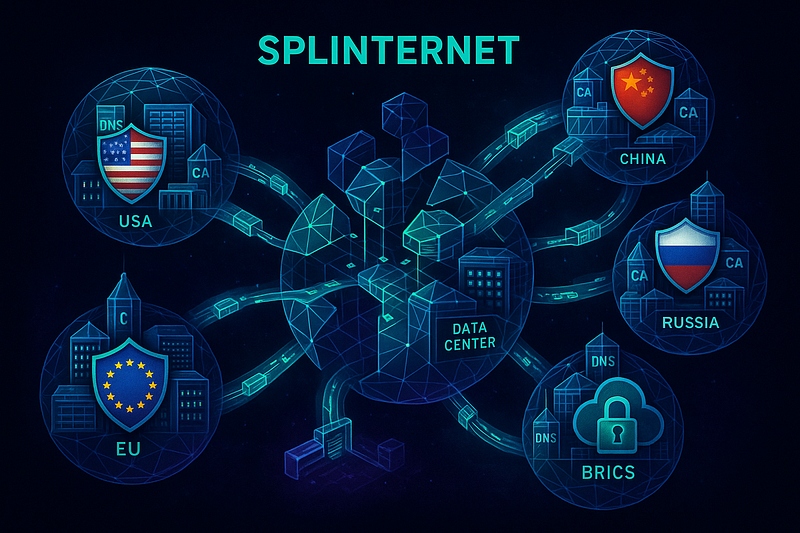
A contemporary dystopian tale could begin like this[1]:
I woke up with my phone already logged into the national superapp: the authentication wristband vibrated, and the trust domain confirmed my “green status” to access basic services. The feed looked normal, but every external link opened a warning: “You are leaving the trust zone; estimated inspection time: 12s”. Bus payment? Only via the sovereign wallet, which also validates my itinerary with the national public key infrastructure; the route was routed through a transfer corridor, and the map showed in red the blocks under speed reduction due to an “unauthorised public event”. Messages from a cousin abroad arrived with gaps — images obfuscated by “incompatible metadata” — and the app asked if I accepted “regulatory conversion”, a filter that re-encapsulates everything into the local standard. I accepted, or I would not see anything.
At work, we tried to open a research repository hosted outside the bloc, but the control point at the network edge required an “adequacy seal” that the university does not yet have; the solution was to upload a mirror to the sovereign cloud, free from foreign dependencies. Near lunchtime, the connection trembled: selective shutdown in three neighbourhoods — the superapp maintained banking, transport, and e-government, but videos disappeared, and calls were voice-only, “for security”. In the evening, I spoke to a friend who travels tomorrow; the digital ticket already came with “compatible routes” and the list of apps that need to be deactivated when crossing the border, otherwise the biometric system locks the boarding. Before sleeping, the feed displayed my “compliance report”: 98% domestic traffic, 2% “interoperated under safeguards”. The statistic seemed like praise. Or a reminder.
How did we reach a situation that could lead us to this? Over the last 50 years, the geopolitical, economic, and legal predominance of the United States has shaped the logical layer of the global internet. We are speaking here of the governance of the most important assets of the worldwide computer network — names and numbers of domain, in addition to the protocols and standards that allow decentralised communication between computers. This infrastructure is almost invisible to web users, but it has been highly disputed and controlled for decades. It is also what sustained the contemporary narrative for years that the internet is an open and democratic network[2]. Even milestones of formal ‘de-Americanisation’, such as the IANA[3]/ICANN[4] transition in 2016, three years after Edward Snowden’s espionage revelations against the big techs and the Obama government, left structural power untouched. This power remains anchored in companies, financial capital, norms with extraterritorial reach (for example, the US CLOUD Act), and standards developed hegemonically by the companies themselves and a captured technical community.
In contrast to internet governance, a historical analysis of telecommunications regulation reveals a consistent effort to reconcile the need for international interoperability with the preservation of national States’ sovereign autonomy in their economic, political, legal, and military dimensions. The creation of the International Telecommunication Union (ITU) in the 19th century, originating from the International Telegraph Union, is the main example of this model, in which States established a multilateral entity to articulate technical and operational agreements that later extended to telephony and radio broadcasting.
In this context, the internet governance architecture represents a notable historical exception. Having expanded under the aegis of neoliberal consensus, which favoured deregulation and private sector leadership, the internet was not structured under a multilateral pact in the ITU mould. Denying its past, the UN agency was merely the stage for the World Summit on the Information Society, which ratified the distancing of national states from internet administration. Had its development occurred in another political-ideological environment, it would be plausible to conceive a distinct governance model, possibly articulated by an existing intergovernmental organisation or a new entity under the aegis of the UN. The absence of this arrangement suggests that the current multi-stakeholder model, with strong prominence of corporations and private technical entities, was not an inevitable outcome of technology but a direct consequence of the historical moment and the dominant ideology during its formation, which privileged free trade and neoliberal policies for the borderless flow of financial capital and digital services[5].
It is interesting to note that whenever digital sovereignty movements are reborn in different countries, the hegemonic voices that control internet governance alongside the United States publicly denounce the “fragmentation of the internet,” baptised as splinternet[6]. This was the case during the Edward Snowden disclosures; during the debate about the GDC; and it has been the case again, now, stemming from Donald Trump’s new mandate in the White House, with some nations anticipating possible political-judicial interventions emanating from Washington.
Unilateral Governance
The response of national States to this unilateral governance of the Internet in recent years has been re-territorialisation: data localisation, technical-regulatory perimeters, effective jurisdiction for platform regulation, and, in extreme cases, disconnection architectures. The result is not a clean cut, but interoperability by exception. Interoperable layers for the common user coexist with sovereign islands for strategic data, finance, government, and critical infrastructures[7]. In 2025, the trend is already palpable in regional normative blocs (such as the reopening of transatlantic data flow by the EU-US under safeguards), national firewalls (China), trials of national segmentation (Russia), and total shutdowns (Iran).
Therefore, although the tale above might lead us to narratives that we are only experiencing censorship and fragmentation on the network, we must not be carried away by the panic raised by the defenders of an essentially US status quo. This is because we might very well view these initiatives as exercises in sovereignty[8] that, once purified of both neoliberalism and authoritarianism, could lead to measures guaranteeing pluralism and democracy. Without a sovereign framework, platforms and providers become vectors of extraterritoriality and administrative decisions taken in Washington capable of imposing divestments, blocking services, and requiring sensitive data from citizens and public bodies. Hence the importance of, instead of a “single internet” governed by corporations and under US extraterritorial policy, national States adopting a digital defence architecture: data under auditable corridors, platforms regulated by due process, and network perimeters with national domain name and number systems. The so-called splinternets with guarantees would not freeze fruition but would relocate power, creating regulatory competition, establishing safe transfer ports, and shielding institutions against interventionist policies. All of this managed by multilateral governance within the scope of the International System.
Systemic Risks
Avoiding dystopian futures involves institutional antidotes. Governments interested in preserving sovereignty with democracy will have to invest heavily in policy transparency, independent perimeter audits, public logs of executive orders, countermeasures to regulatory capture, and swift judicial review. This transforms fear into a constructive agenda.
The hypothesis we wish to affirm here is that the corporate and US governance of the network of networks — combined with geopolitical competition for data and infrastructure — is accelerating a pluralism of internets around the globe. This is not censorship by default. These are experiences of constitutional network engineering that give national States proportional instruments (data, platforms, perimeter) to ensure continuity, sovereignty, and fair competition in the face of corporate and US jurisdictional power. Instead of closure, we can view the measures as intelligent compartmentation whose objective is defence and resilience, not isolation. Just like any type of flow between countries, of goods, of people, of sensitive products, the internets can connect through a series of mechanisms of cooperation and shared operation.
This arrangement would be justified by three systemic risks that are recurrently knocking at our door. The first of these is extraterritoriality, which finds its best definition of threat hanging over countries in the CLOUD Act[9]. An internet protected from external interventions would block access to strategic data, prevent attacks on democratic political systems, and, most importantly, reduce the chances of cyber wars acting upon the territory of each nation. In the economic field, being able to balance the actions of national and foreign agents would enable healthier and fairer digital ecosystems. It would be a way to prevent the creation of gatekeepers with sufficient market power to expand entry barriers and build lock-in effects that currently hold us hostage to certain foreign conglomerates. The geopolitical instabilities we currently face would be more easily governed. Abrupt changes in posture, as we recently saw in the divest-or-ban line in the TikTok case in the US and the issuing of sanctions and executive orders with extraterritorial effect, as occurs with the Magnitsky Act, would have less effect if they could not enter digital borders.
Some nations have already realised they needed to tread the more sovereign path and have been doing so with greater intensity since 2020, albeit for diverse motivations and according to their political-institutional systems. Given this, it is no longer mere conjecture to state that by the end of the decade, we may be talking not about the Internet, but about the Internets.
China: Programmed Sovereignty, Pragmatic Flexibility
Since the late 1990s, China has consolidated a doctrine of internet sovereignty combining perimeter control (the famous Great Firewall), technological substitution, and a robust data regime. The technical perimeter — filtering/inspection, DNS/HTTPS blocking, middleboxes — sustains the autonomy of platforms and data, while the State strictly regulates content and digital services.
In 2024, Beijing relaxed some of the requirements for cross-border transfers, creating exceptions and compliance corridors to unlock investment, without abandoning the principle that “important data” and critical sectors remain under national security assessment. This is a calibrated sovereignty: control valves are maintained while the system opens breathing room for economic growth and foreign direct investment. This has the strategic effect of creating an internet highly compatible “on the outside” — for commerce and innovation — but with a sovereign heart that can operate in closed mode when activated for national security reasons.
From an economic perspective, this arrangement allowed the government to protect the national market from foreign competition, which generated its own big techs and a connected population consuming content, goods, and services originally produced in the country.
Russia: From “RuNet” to National Public Keys
With the Sovereign Internet Law (2019), Russia created a framework for centralised traffic management, disconnection tests, and a national DNS. After 2022, it advanced upon the HTTPS trust layer, promoting a state Certification Authority (CA) for TLS, aiming to reduce dependence on global CAs and circumvent sanctions.
In practice, this allows the State to intermediate trust and, ultimately, nationalise the cryptographic legitimacy of the Russian ecosystem — a decisive piece in the engineering of an “internet-Russia”. By internalising DNS and certificates, Moscow converges towards a network capable of operating in island mode, whatever the cost to external interoperability.
Throughout this year, the Putin government has been moving towards the development of a sovereign digital ecosystem with a backbone. The entry point is MAX, the state superapp developed by the Russian social network VK. The application has become pre-installed on all smartphones and tablets sold in the country and integrated with the Gosuslugiportal for authentication, public services, and payments — a strategic step to centralise communications and digital public services in a single hub.
In parallel, the State restricted functions of rivals (such as voice/video calls on WhatsApp and Telegram) to encourage migration to MAX, and expanded the sovereign stack with the mandatory use of domestic stores and apps (such as RuStore on devices and state TV apps on Smart TVs, the Lime HD TV, starting in January 2026), reinforcing regulatory control and operational continuity of digital services under Russian jurisdiction[10]. There are restrictions on voice/video in WhatsApp and Telegram, blocking of Facebook/Instagram, restrictive law on private networks (VPNs), and reports of YouTube throttling on computers (up to 70%), in addition to mobile interruptions to thwart Ukrainian drone attacks.
Countries Expanding the “Splinternet”
Russia and China are no longer alone in this movement. In recent years, we can speak of at least seven other blocs or populous countries walking in the same direction. To avoid making this text too long, we compiled as follows:
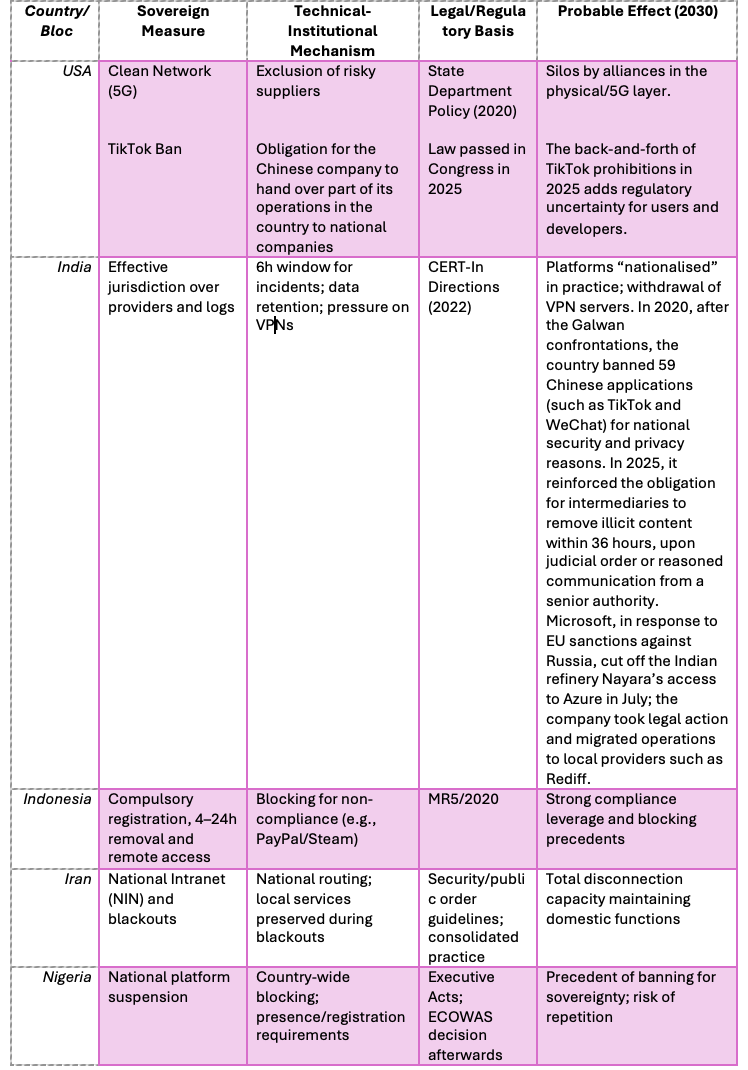

What predominates in these experiences is a pattern of “selective interoperability,” through which they open up to commerce and innovation while creating the possibility of closure to contain sovereign risks. The consequence is a regulatory mosaic with high compliance costs and case-by-case negotiation with national regulators. A dynamic has been created that hierarchises the technical-institutional tools to be used. Data re-territorialisation becomes the backbone of digital sovereignty: compulsory localisation, regional adequacy, and standard clauses create transfer corridors with legal and technical safeguards, where flow exists, but in monitored lanes. In this logic, effective jurisdiction for platform regulation shifts the centre of gravity within borders, demanding the presence of local representatives, rigid removal deadlines, progressive fines, and technical sanctions convert global companies into subjects of jurisdiction. At the same time, network perimeters — national DNS/PKI[12][13], filtering and inspection in middleboxes, controlled routing — replace the diffuse trust of the open internet with trust domains calibrated by each State.
When pressure mounts, selective or total shutdowns enter the picture, used in public order and hybrid warfare, supported by internal networks that ensure domestic continuity of critical services. Above this layer, industrial policy and technological alliances shape the rest of the map. Exclusions are created, as in the case of 5G, sovereign cloud for the State, export controls, sensitive sectors, and the installation of trust zones by blocs. The vision that emerges for the 2030s is that of a global ecosystem interoperable by exception. Transit will be conditioned by safeguards, platforms conditioned by local rules, and federated trust infrastructures — a mosaic that seeks to balance strategic autonomy, resilience, and innovation under verifiable parameters.
The construction of sovereign clouds, for instance, has become a global trend since 2019[14]. Countries such as Germany, France, Brazil, Singapore, and Israel are developing national data infrastructures in partnership with large cloud computing service operators (hyperscalers)[15], but under local jurisdictional control. The global sovereign cloud market, valued at US$ 96.77 billion in 2024, is expected to reach US$ 648.87 billion by 2033[16]. These clouds are not isolated, as they operate as “trust domains” that connect to other domains through adequacy agreements and safeguards, such as the Data Privacy Framework (DPF) between the European Union and the US.
BRICS and UN
Given this context, it should be noted that BRICS has emerged as the most articulated bloc in constructing a digital architecture alternative to US hegemony. Since the launch of the BRICS Digital Economy Partnership Framework in 2022[17], the group has coordinated initiatives across multiple layers of digital infrastructure. In the physical layer, the 17th Rio de Janeiro Summit, in July 2025, approved a technical and economic feasibility study for the construction of its own network of submarine fibre optic cables connecting the 11 member countries directly, to be financed by the New Development Bank. As President Luiz Inácio Lula da Silva declared on the occasion, this infrastructure “will increase the speed, security, and sovereignty in data exchange,” responding to the fact that existing cables are controlled by companies in the Global North[18].
In the data and services layer, the bloc has advanced cooperation in cybersecurity (with a ministerial meeting in Brasília in April 2025[19]), the development of artificial intelligence with its own governance, the exploration of sovereign digital currencies, and an understanding of data economy governance[20]. Representing 48.5% of the world population and 39% of the global economy, BRICS demonstrates that digital sovereignty is not just a defensive response by authoritarian regimes, but a development strategy adopted by emerging economies seeking to reduce power asymmetries in internet governance and guarantee autonomy over their strategic digital assets.
Within the scope of the UN, Secretary-General Antonio Guterres has struggled to approve the Global Digital Compact (GDC), which aims to bring greater multilateral governability to the current digital agenda arrangement. As usual, every initiative that encourages the sovereignty of the member countries of the international system has faced strong resistance from the US, its allies, the private sector, and even segments of civil society, with the same argument as always about a potential risk of censorship, an argument that tends to preserve the status quo. The so-called technical community, always filled with technology company executives, has published open letters to condemn the movement around the GDC that threatens the monopoly on defining standards and protocols for the Internet. In practice, this historically resembles the fight against the creation of an organisation like the ITU and the preservation of the predominance of private governance by a few people and companies.
Asymmetric Bans
The initiatives for the end of unilateralism, a recent analysis in The Telegraph [21] sustains, are beginning to transform the world wide web into something like the where permitted web, with countries developing their sovereign internets to ensure limits on content distribution and communication transactions. Bans, blocks, requirements, and deadlines have become routine in some of these countries we listed. The variety of treatments for the Internet in each country creates a paradox for those travelling through different countries. With international roaming, the newspaper reporter managed to access Facebook and Google, banned in China, while TikTok remained inaccessible because it was vetoed in India. Obviously, asymmetric bans generate incongruent experiences for the same user.
We can classify the actions of these countries into four categories: localisation and adequacy (India, Vietnam, EU-DPF case) resulting in the flow of information under safeguards; regulation and technical sanctions (Turkey, Indonesia, Pakistan) with local compliance without a “total blackout”; intranets and shutdowns (Iran and China) with domestic continuity and safeguards[22]; and sovereign trust stacks (Russia) with local actors.
In the logical layer of the network, the proliferation of regional and national Internet Exchange Points (IXPs) materialises this re-territorialisation trend. IXPs are the physical locations where different networks exchange traffic directly, without intermediaries, functioning as “roundabouts” for data flow. Globally, the number of active IXPs has grown rapidly, jumping to 1,012 points in October 2025, with a total capacity of 2.19 Terabits per second[23]. Growth is especially notable in developing regions: in Africa, operational IXPs increased from 36 in 26 countries (2016) to 63 in 38 countries (2024), according to the Coalition for Digital Africa[24]. This movement reduces dependence on expensive and inefficient international routes — where, without local IXPs, a simple email sent to a neighbour might cross continents before reaching the recipient. By keeping local traffic within national or regional borders, IXPs not only reduce costs and latency but also grant States greater control over domestic data flows. It is, therefore, an infrastructure that, although promoting interconnection, does so under conditions increasingly defined by criteria of sovereignty and geographical proximity, reinforcing the logic of national internets with controlled intersection points.
Functional Pluralism and Compatibility Corridors
Analysing these movements, it is possible to prognosticate what we will see next. In the medium term, the world network tends to operate in functional bipolarity: on one side, the US-allies axis; on the other, China and partners. The two halves will not be walls, but systems with conditioned bridges — data adequacy decisions, cross-certifications between trust chains, and audit roadmaps for sensitive flows. Large platforms become multi-sovereignty companies: different policies per jurisdiction, corporate diplomacy, asymmetric regulatory costs, and compliance architectures that alternate resources, logs, and content models according to the regulatory border they cross.
At the same time, regional sovereign architectures outside the bipolarity should emerge. India, ASEAN, and Turkey will consolidate their own regulatory stacks, combining data localisation, platform governance, and security requirements with industrial development goals. The keyword is selective interoperability: they connect when there are economic gains and demonstrable technical trust; they compartmentalise when sovereign risk increases. The result is a mesh of regional agreements, with certification hubs, Public Key Infrastructures (PKI) recognised in the bloc, and transfer corridors that couple digital economy and foreign policy.
Finally, the internet will compartmentalise by criticality. For the common citizen, everyday life will continue on global platforms with manageable friction; for critical chains — finance, e-government, industrial IoT — traffic will circulate only through trusted domains, supported by national or federated PKIs and DNS, transparency registers, and periodic audits. This engineering will create a smaller attack surface, continuity of services in crisis situations, and the capacity for selective shutdown without collapsing the ecosystem as a whole — an internet that will remain open in experience, but closed where sovereignty and risk demand it.
Implications for Brazil
Historically known for its unconditional support for the hegemonic neoliberal view within the circuit that has governed the Internet unilaterally for decades, starting from the United States, Brazil has options to create its own internet[25]. The first stitching would be juridical and institutional via data compatibility agreements (adequacy decisions and “safe harbours”) accompanied by procedural safeguards, proportionality clauses, and independent audits that ensure rights, security, and regulatory predictability. Instead of accepting cross-border flows as “all or nothing,”[26] the country can design conditioned transfer corridors based on sectoral risk (health, finance, government), with clear compliance pathways for companies — national and foreign — and effective appeal mechanisms for citizens.
This data architecture converses directly with platform governance. Legislation that ensures due process in content removal orders, proportional algorithmic transparency (focused on material impacts, not industrial secrets), and gradual sanctions — ranging from improvement commitments and fines to proportional technical measures — would create an environment where public interest is not confused with censorship, and legal predictability favours innovation. The objective is to balance accountability and freedom, replacing arbitrariness with verifiable procedures and calibration by risk.
To sustain this ambition, Brazil would need what we are calling trust infrastructures. Since 2001, the country already has a robust national public key system (ICP-Brasil) and is among those with one of the largest traffic exchange points in the world and entities that have implemented sovereign clouds. In 2025, it actively participated in BRICS discussions on proprietary digital infrastructure, including submarine cables and AI cooperation. Brazil’s strategic position as an anchoring point for submarine cables[27] in the South Atlantic reinforces its relevance in any “federalism of trust” architecture. This would involve the restructuring of critical asset coordination based on a robust and auditable national PKI, secure domain systems with modern authentication and resilience practices in the hands of the State, in addition to a sovereign cloud for state functions and critical sectors (justice, revenue collection, social policy, cyber defence). This technical base would integrate with digital industrialisation with the local installation of data centres, even if foreign, with counterparts in qualification and energy efficiency; focus on semiconductors with realistic windows for productive linkages; and fostering an open-source software ecosystem that reduces lock-ins and increases the technological autonomy of the public sector and small and medium-sized enterprises.
Closing the cycle, active technical diplomacy without capture would be essential: leadership in internet governance forums seeking multilateralism, economic and standardisation blocs (IETF, ITU, ISO, OECD, G20, BRICS), defending bridges between blocs — interoperability under safeguards, federated trust between PKIs, and evolving standard clauses — and articulating coalitions around verifiable principles (rights, security, open innovation). The strategy is to transform the “splinternet” into a network of reliable networks, in which Brazil is not merely a rule-taker, but an architect of compatibilities that expand autonomy, attract investment, and protect the national interest.
Towards Multilateral Governance: Principles for the Federalism of Trust
With this, Brazil can bring to the International System a proposal for effective multilateral internet governance in the 21st century. This decision-making architecture can no longer be based on the “multi-stakeholder” model which, in practice, consolidated North American and corporate hegemony, pushing sovereign nations away. The viable path is a federalism of trust anchored in multilateral institutions — particularly the UN, through the ITU or a new specialised body — that recognises digital sovereignty as legitimate but conditions it upon respect for verifiable principles. This also involves an assessment of the role of private entities like ICANN and IANA which, in practice, call the shots on the global internet and privatised its governance decades ago.
This governance should focus on five critical points for the establishment of the new internets:
- Cross-certification of trust infrastructures, creating a system of mutual recognition between national and regional PKIs, with independent audits and mandatory transparency;
- Evolving standard clauses for data transfer, replacing unilateral adequacy decisions with bilateral and multilateral agreements with clear procedural safeguards, adaptable to different legal contexts;
- Minimum due process standards for platform regulation, ensuring that content removal orders, blocks, and technical sanctions are reasoned, proportional, judicially reviewable, and publicly documented;
- Mandatory technical interoperability mechanisms, preventing network perimeters from becoming absolute walls, with open protocols for traffic exchange between regional IXPs and minimum compatibility between national DNS; and
- Transparency and limits for shutdowns, establishing that total or selective internet disconnections are exceptional, temporary measures, internationally notified, with mechanisms for contestation and reparation.
A configuration like this would not eliminate tensions between sovereignty and global presence, but would shift them to a terrain of institutionalised negotiation, where power would not be exercised unilaterally by one State or by opaque private entities. It would be a space mediated by norms, procedures, and collegial multilateral arbitration instances. The objective is not to restore the single internet of the past — a historically impossible and politically naive project — but to build a regime of regulated interoperability that preserves innovation, protects fundamental rights, and recognises the diversity of digital governance models, provided they operate within democratic boundaries and are mutually auditable. In this scenario, fragmentation would cease to be an existential threat and would become a managed plurality: multiple internets, yes, but connected by solid, transparent, and reciprocally legitimised bridges.
From Splinternet to Meltnet
After reviewing the evidence presented so far, it becomes easier to ascertain that “fragmentation” is a self-interested concept that has been used to delegitimise the principles of self-determination of peoples and national sovereignty. The internet of the coming years will be less universal and more conditional, almost a fusion of national networks, which we could call meltnets. The good news is that there is room for pluralism with guarantees. The strategic vision is to build compatibility corridors that preserve freedoms and innovation, while simultaneously recognising the right of States to protect critical data and infrastructures.
The internets the world needs do not erect walls, but install auditable “circuit breakers”. If we execute well — clear metrics, deadlines, independent audits, interoperability under safeguards — big techs will return to being contracted infrastructures, not constituent powers; external political cycles will cease to dictate our connectivity; and innovation will flourish with sovereignty, competition, and rights. Just as we cannot endorse the submission of the internets to mere whims of a ruler or political group, we must work to create a “federalism of trust” formed by sovereign domains operating jointly through cross-certification, conformity, standard clauses, and multilateral governance. The anchor principle should be interoperability conditioned by legal norms such as due process, proportionality, and audit. 21st century digital sovereignty is not isolation — it is the capacity to choose, audit, and interoperate under clear rules to keep the Internet plural and free.
This is a possible tale to be realised.
[1] See glossary for the technical terms referenced in this article: James Görgen, Medium 27/10/2025. https://florestadigital.tec.br/gloss%C3%A1rio-de-termos-de-governan%C3%A7a-da-camada-l%C3%B3gica-da-internet-543064e0da86
[2] James Görgen, Outras Palavras, 10/05.2025: https://outraspalavras.net/tecnologiaemdisputa/a-internet-e-a-armadilha-do-consenso/
[5] Blayne Haggart, Jan Aart Scholte and Natasha Tusikov. Power and Authority in Internet Governance: Return of the State?, 2021. https://library.oapen.org/handle/20.500.12657/93063
[6] The splinternet is the transition from a presumably unified internet to a plural and compartmentalised ecosystem, in which States and regulatory blocs erect sovereign perimeters — through data localisation, the “domestication” of platforms (local representatives, deadlines, and technical sanctions ), the nationalisation of trust (proprietary DNS/PKI), filtering/inspection, and content geofencing — to reduce dependencies and project power over informational flows and critical infrastructures. Driven by national security, technological/industrial competition, and extraterritorial jurisdictions, the splinternet maintains layers still interoperable for the user, which coexist with compatibility corridors and high-reliability zones for, for example, finance, government, and IoT.
[7] CBRE, Global Data Center Trends, 2025, 24/06/2025. https://www.cbre.com/insights/reports/global-data-center-trends-2025
[8] Dennis Broeders, Journal of Cyber Policy, Vol 2, 2017: https://www.tandfonline.com/doi/abs/10.1080/23738871.2017.1403640
[9] Emily Osborne, What does a ‘sovereign cloud’ really mean, 20/10/2025. https://techpolicy.press/what-does-a-sovereign-cloud-really-mean
[10] Andrew Osborn. https://www.reuters.com/technology/russia-orders-state-backed-app-whatsapp-rival-be-pre-installed-all-phones-2025-08-21/
[12] PKI, or Public Key Infrastructure (Public Key Infrastructure ) is the network’s “cryptographic registry office”: a system of standards, hardware, software, and certified entities that allows for the secure identification of people, servers, and devices and the protection of data (confidentiality, integrity, authenticity).
[13] https://onlinelibrary.wiley.com/doi/10.1002/nem.2309
[14] Shoaib Yousuf, Mahmood Serry: https://www.bcg.com/publications/2025/sovereign-clouds-reshaping-national-data-security
[15] Mark Minevich, Simon Ninan: https://observer.com/2025/09/sovereign-data-centers-global-ai-power/
[16] https://www.grandviewresearch.com/industry-analysis/sovereign-cloud-market-report
[17] BRICS Digital Economy Partnership Framework, 2022: https://economy.gov.ru/material/file/f27728237d888e78716ed5e2630101be/BRICS%20Digital%20Economy%20Partnership%20Framework.pdf
[19] https://brics.br/en/news/brics-strengthens-cooperation-on-cybersecurity
[21] Sevanti Ninan, 27/10/25. https://www.telegraphindia.com/opinion/digital-disconnect-access-to-the-digital-world-is-diminishing-the-world-over-prnt/cid/2129750
[22] OECD. https://www.oecd.org/en/topics/sub-issues/cross-border-data-flows.html
[23] Internet Society Pulse. https://pulse.internetsociety.org/en/ixp-tracker/
[24] Ecofin Agency, 25/08/2025. https://www.ecofinagency.com/news-digital/2508-48137-internet-exchange-points-the-hidden-hubs-making-internet-access-more-affordable-in-africa.
[25] Marcos Dantas, 14/05/2024. https://www.correiodobrasil.com.br/a/net-apos-dez-anos-caminhos-bifurcam.
[26] Data Privacy Blog, 27/10/2025. https://www.sovy.com/blog/data-sovereignty/.
[27] In July 2025, the BRICS countries approved a feasibility study for the construction of their own network of submarine cables, financed by the New Development Bank.